
 Contact us
Sep 2, 2026•5 min read
How Metal Price Volatility Is Reshaping Office Fit-Out Costs in India
Read More
Written by: Aaradhna
Published at: 07/28/26

Nearly 16 global capability centres were opened every month for the first six months of the year in India. According to the latest research from Altre, India recorded over 95 new and expanding Global Capability Centre setups in H1 2026, roughly 35% more than the same period in 2025. In this blog, we breakdown the trends that we have noted across sectors, cities, and headquarters geographies in H1 2026.
First point of order, the 95 figure for H1 2026 covers both new entrants (i.e. first time GCC set ups) as well as new units from GCCs already in India. In terms of their respective share of the figure, 51% were new GCC setups, and 49% were expansions of existing centres (47).
The reason why this is number to note is the trend cycle. Geographical markets in early in their growth phases typically show new-entry-heavy patterns. On the other hand, markets in consolidation phases show mostly expansions. A near-equal split means both are running simultaneously in India. While new companies continue to arrive, existing ones are far enough along that they are also beginning to scale up.
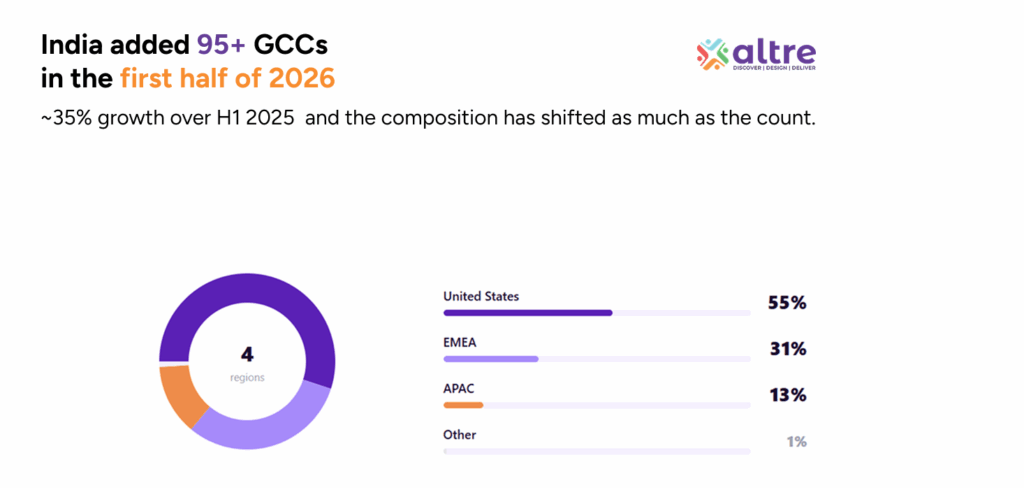
Despite macro-economic situation and headwinds, American firms continued to deepen their investments and presence in India. The 600 basis point increase YoY from 49% was seen across industry segments like financial services, technology, and consumer sectors. Some of the names that from the US involved in GCC setups include Apple, Charles Schwab, Walt Disney, Target, S&P Global, Honeywell, and Kraft Heinz.
Moving across the Atlantic, the 1100 basis point drop in EMEA's GCC contribution stands out the most. However, let's add some context. European companies were among the most aggressive new entrants to India's GCC market in previous years, including some of the most early entrants. EMEA companies active in H1 2026 include MANN+HUMMEL, Airbus, Reckitt, UBS, Thales, and Nestlé: a mix of industrial engineering, FMCG, financial services, and aerospace.
APAC's move from 11% to 13% is gradual but directionally consistent. Japan, Australia, and Southeast Asian companies are steadily building India into their global delivery structures, and the APAC cohort in H1 2026 includes pharma, financial services, and IT companies operating across both primary and notably tier 2 markets.
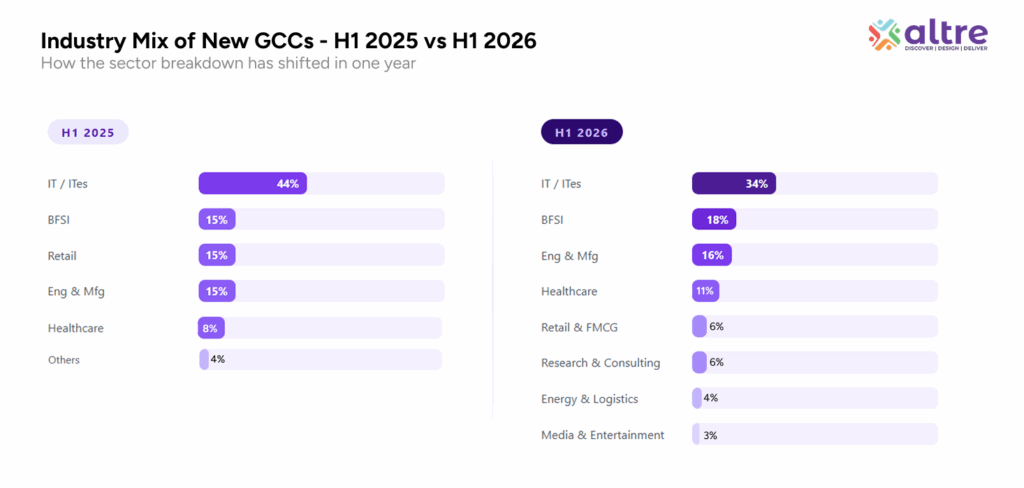
In H1 2025, the industry breakdown of new GCCs was: IT/ITeS at 44%, BFSI at 15%, Retail at 15%, Engineering and Manufacturing at 15%, and Others (including Healthcare, Gaming, etc.) at 12%. By H1 2026, that picture has changed across the board:
IT/ITeS: 34%, still the largest single sector, but down 10 percentage points from H1 2025.
BFSI: 18%, up from 15%, with financial services GCCs moving into more technically specialised functions.
Engineering and Manufacturing: 16%, a marginal increase, but notable for the complexity of work arriving, including semiconductor design, aerospace engineering, and clean energy R&D.
Healthcare: 11%, with medtech, pharma R&D, and healthcare AI companies making India moves in meaningful numbers for the first time.
Retail and FMCG: 6%. Research and Consulting: 6%. Energy, Logistics and Infrastructure: 4%. Media and Entertainment: 3%.
The IT/ITeS shift deserves its own read. A 10 percentage point drop in one year could look alarming, but the absolute number of IT/ITeS GCCs entering India has not necessarily fallen: the denominator has grown as other sectors have stepped up. India's GCC addressable market now extends into life sciences, financial technology, industrial engineering, and media technology in a way it did not two years ago.
Healthcare's emergence at 11% is arguably the most structurally significant shift in the industry data. Companies like Zimmer Biomet, Boston Scientific, and Cohere Health choosing India in H1 2026 point to a pharma and medtech GCC wave that has been building for a few years and is now large enough to register separately. Hyderabad's Genome Valley cluster is a specific draw for this cohort: the proximity to biopharma manufacturing, combined with a deep pool of life sciences talent, makes Hyderabad competitive for healthcare GCC mandates in a way that was not as visible in H1 2025 data.
BFSI's rise to 18% reflects financial services companies moving into India for more than processing and compliance. Trading technology, investment management platforms, and financial risk functions are increasingly being built here, reflected in names like Charles Schwab (Gachibowli), LPL Financial (Financial District, Hyderabad), and Fidelity (Chennai) among H1 2026 occupiers.
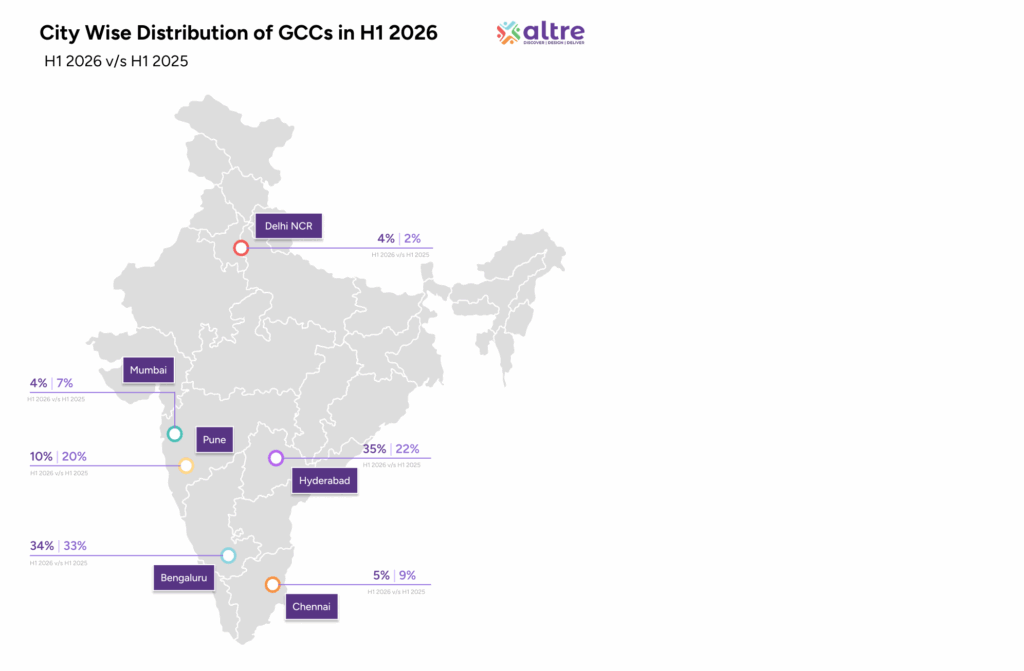
In H1 2025, Bengaluru held 33% of total GCC entrants and Hyderabad held 22%. By H1 2026, Bengaluru's share of new setups held at 34%, broadly stable, while Hyderabad's share of total GCCs jumped to 35%, and its share of new setups in H1 2026 reached 41%.
Hyderabad's GCC share rising from 22% to 35% in a year reflects how aggressively the city has absorbed demand. Its share of new setups (41%) now exceeds its total share of GCCs (35%), which means new demand is accruing to Hyderabad faster than its installed base would suggest.
Bengaluru's 34% share of new setups is not a secondary position: it means nearly 1 in 3 GCCs in H1 2026 chose Bengaluru. The ORR corridor remains the dominant micro-market for large GCC mandates. The Whitefield cluster continues to attract engineering-heavy occupiers. Even the CBD is part of the active Bengaluru GCC map. For a full breakdown of city-level absorption and Grade-A supply, see Altre's India Office Leasing Landscape Q1 2026 report.
Pune held 20% of GCCs in H1 2025 but contributed only 10% of new setups in H1 2026: its existing base is stabilising rather than receiving a large wave of new GCCs in this period. Chennai moved from 9% in H1 2025 to 5% in H1 2026, with 2% of new setups; the city has a specialised occupier profile in BFSI and healthcare IT, but large new mandates are flowing toward Bengaluru and Hyderabad. Delhi NCR moved from 2% in H1 2025 to 4% in H1 2026 with 4% of new setups, reflecting a stabilising market with a defined occupier base rather than rapid expansion, a picture that Haryana's GCC Policy 2026 is specifically designed to change. Mumbai's GCC profile remains anchored in financial services and media, with new-setup activity limited in H1 2026.
Bengaluru and Hyderabad together captured over 80% of new GCC setups in H1 2026. The other cities are consolidating, specialising, or in early build. For a deeper read on why the Bengaluru and Hyderabad split plays out the way it does, Altre's city guide covers deal-level data across both markets.
Tier 2 cities registered 7% of total GCCs in both H1 2025 and H1 2026, with 6% of new setups in the latest period.
In earlier periods, tier 2 GCC activity was dominated by IT services and staffing companies. What is visible in H1 2026 is a more varied first-mover cohort. Eisai, a Japanese pharmaceutical company, chose Visakhapatnam for a dedicated Knowledge Centre, making it one of the more unusual location choices in the dataset. NTT Data's move to Vizag's Inspiredge Building in Rushikonda puts a Japanese IT major alongside a pharma company in the same city. A city drawing demand from different sectors simultaneously is usually how a durable GCC ecosystem begins.
Velir's Jaipur setup in digital experience and AI, Simplain in Coimbatore for IT services, and Xpheno's recruitment operation in Udupi each represent different cities finding their first-mover GCC anchors. Vadodara has Collabera. GIFT City is on a separate trajectory with DSP's entry via GoodWorks GCC Nexus at Prestige Tech Park, functioning less like a tier 2 market and more like a purpose-built financial district that is increasingly institutionalised.
The talent case for tier 2 rests on engineering and science graduate output from local institutions, substantial in cities like Vizag (GITAM, Andhra University, JNTU), Coimbatore, and Jaipur, combined with retention dynamics that are structurally more stable than in primary markets. Whether this cohort of first movers translates into a broader wave in H2 2026 or 2027 is one of the more open questions the current data raises but does not yet answer.
The diversification of sectors from IT/ITeS at 44% in H1 2025 to a more distributed mix in H1 2026 means that talent demand is becoming more varied. Healthcare AI engineers, semiconductor designers, aerospace engineers, and financial risk modellers are now all part of the GCC talent conversation in India, alongside the software developers and data analysts that have always been here. That broadening creates opportunity and competition in equal measure: more types of work can be placed in India, but specialised talent is finite and is now being pursued by a wider set of organisations.
India's primary markets continue to punch above their weight on real estate supply. Micro-markets like ORR in Bengaluru, Gachibowli and Financial District in Hyderabad, and Kharadi in Pune are consistently absorbing larger deal sizes without stalling, a function of supply pipelines that have kept pace with rising GCC demand. Globally, few markets offer Grade-A office infrastructure, GCC-ready campuses, and competitive pricing at this scale, and that combination is what keeps deal velocity high even as mandate sizes grow.
The multi-city strategies visible in some occupiers, including Apple operating in both Bengaluru and Hyderabad and US Bancorp across Hyderabad and Chennai, reflect deliberate talent diversification rather than supply constraints: a signal of how mature GCC operators think about India as a distributed network rather than a single-city bet.
Tier 2 remains an option that rewards early movers but requires a longer planning horizon and a realistic view of what infrastructure and ecosystem currently exist versus what is being built.
For a detailed view of GCC location strategy, micro-market dynamics, and lease benchmarks across India's top cities, explore Altre's Business Location Advisory platform or connect with our advisory team. Read the full report here for more insights.
The H1 2026 data shows 35% more setups than H1 2025, a broader sector mix, and a more concentrated city picture than any prior period in the data.
Whether the talent pipeline, real estate supply, and policy infrastructure continue to keep pace as the quality and complexity of GCC demand rises, that is the question H2 2026 will begin to answer.
How many GCCs were set up in India in H1 2026?
India recorded 95+ GCC setups and expansions in H1 2026, roughly 35% more than the same period in 2025, according to Altre's proprietary tracking of GCC activity across India's top office markets. The 95+ figure covers both greenfield new setups (51%) and expansions of existing centres (49%).
Which city had the most GCC setups in India in H1 2026?
Hyderabad led new GCC setups in H1 2026, capturing 41% of new entries, up from 22% of total GCC stock in H1 2025. Bengaluru held 34% of new setups. Together, the two cities captured over 80% of new GCC demand in the first half of 2026.
Which sectors saw the most GCC growth in India in H1 2026?
IT/ITeS remained the largest sector at 34% of new GCCs, down 10 percentage points from H1 2025's 44%. BFSI grew to 18%, engineering and manufacturing to 16%, and healthcare emerged at 11%, reflecting a pharma and medtech GCC wave now large enough to register separately in the data.
Why did healthcare GCCs grow in India in 2026?
Companies including Zimmer Biomet, Boston Scientific, and Cohere Health chose India in H1 2026, reflecting a pharma and medtech GCC wave building over several years. Hyderabad's Genome Valley cluster is a specific draw, combining proximity to biopharma manufacturing with a deep life sciences talent pool.
What is the GCC activity in tier 2 cities in India in 2026?
Tier 2 cities registered 7% of total GCCs in H1 2026 with 6% of new setups. The notable shift is compositional: earlier tier 2 activity was dominated by IT services, while H1 2026 shows more sector diversity, including Eisai (pharma) in Visakhapatnam, NTT Data in Vizag, Velir (digital experience and AI) in Jaipur, and GIFT City continuing its institutionalisation as a BFSI GCC destination.
Which country headquartered the most GCCs entering India in H1 2026?
US-headquartered companies accounted for 55% of GCC setups in India in H1 2026, up from 49% in H1 2025. Active US occupiers included Apple, Charles Schwab, Walt Disney, Target, S&P Global, Honeywell, and Kraft Heinz. EMEA dropped from 40% to 31%, with European companies in a comparatively less aggressive first-entry phase following several years of high new-setup volume.
Source: Altre Research H1 2026 GCC Tracker; Altre and Inductus GCC Landscape Report 2025. Data based on Altre's proprietary tracking of 3,600+ commercial properties and GCC activity across India.
Published: July 28, 2026
Discover more insights and expert perspectives on commercial real estate and business growth

Copyright © 2026. All rights reserved.