
 Contact us
Sep 2, 2026•5 min read
How Metal Price Volatility Is Reshaping Office Fit-Out Costs in India
Read More
Written by: Vidushi Kajla
Published at: 09/24/26

Banking, Financial Services and Insurance (BFSI) has become one of the biggest occupiers of Grade A office space in India, and almost all of that demand sits in three cities. Mumbai, Bengaluru and Hyderabad hold close to 70% of the country's total BFSI office footprint between them. Mumbai has the largest share right now, with Bengaluru close behind it. Hyderabad is the one worth watching though; it has all but caught up to Bengaluru, and it is growing faster than either of the other two.
Industry commentary frequently ranks these three cities against one another, implying the existence of a single market leader. This framing, however, does not reflect how BFSI organisations approach office leasing decisions in practice. A regulatory compliance function and a technology-led capability centre carry fundamentally different real estate requirements, notwithstanding that both transactions are classified under BFSI leasing activity. The more relevant consideration is not which city ranks highest in aggregate, but which city is best suited to a specific business function, and the implications of that alignment for long-term office fit out and occupancy planning.
These figures draw on Altre's India BFSI Industry: Office Market Insights 2026 report, which tracks leasing activity, rents and top occupiers for the sector across eight Indian cities.
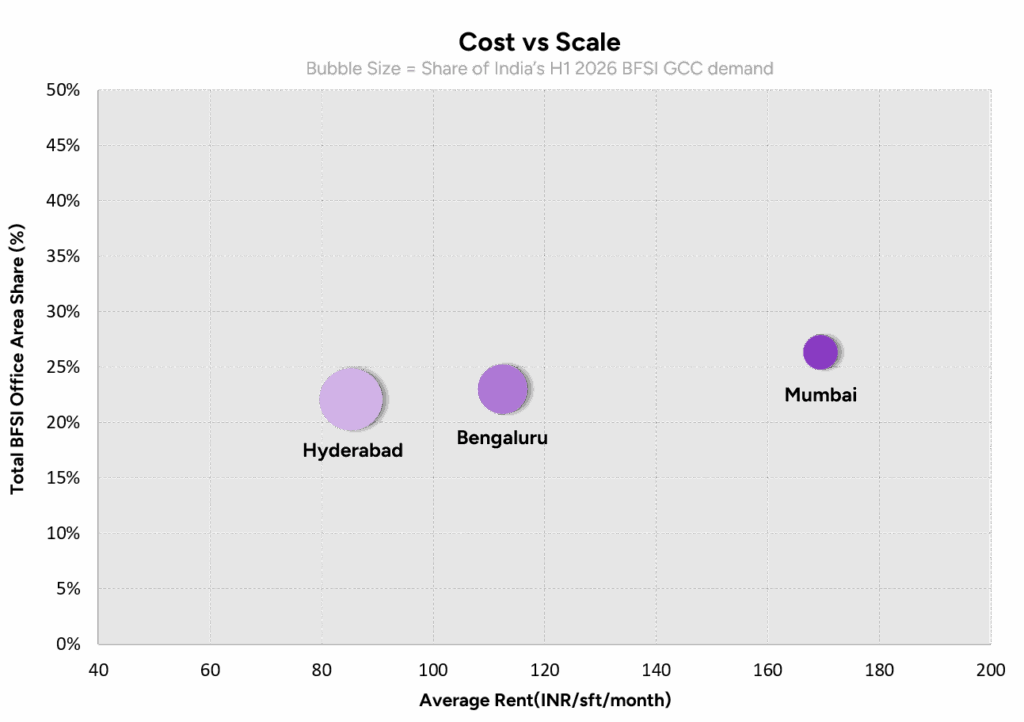
Mumbai's share of national BFSI office stock is the largest of the three cities, and its rents reflect that position. Grade A space averages close to ₹170 per sq ft per month across the city as a whole, and within Bandra Kurla Complex and Central Mumbai, headquarters-grade addresses can command ₹300 to ₹500 per sq ft per month, among the highest rates in the country's commercial real estate.
This pricing has not diminished occupier demand, nor was it ever likely to, given that Mumbai's appeal has never rested on cost competitiveness. The city's value lies in proximity: to regulators, to capital markets, to the institutions that determine the direction of Indian finance. Most major banks, insurers, private equity firms and asset managers, both domestic and international, maintain their headquarters or most senior decision-making teams in Mumbai, reflecting the continued importance of physical proximity to regulators and clients within this sector.
This factor shapes the composition of Mumbai's leasing activity. The city attracts front-office, business-critical functions rather than large operational centres, investment banking, treasury, wealth management, capital markets, corporate banking and executive leadership, roles for which physical proximity to counterparties materially influences business outcomes, rather than serving merely operational purposes.
For organisations whose operations depend on proximity to clients, investors and regulators, the rental premium associated with Mumbai is generally regarded as a necessary cost of doing business rather than a purely economic consideration.
Availability presents a further constraint in this market. Large, contiguous Grade A floor plates remain genuinely limited in Mumbai relative to Bengaluru or Hyderabad, particularly across BKC and the western suburbs, where the majority of demand is concentrated. Occupiers that delay commitment risk being confronted with a reduced footprint or a longer commute for staff, which is a principal reason pre-leasing discussions tend to progress more rapidly in Mumbai than in either of the other two markets.
Segments best suited to Mumbai:
Bengaluru is the second-largest BFSI office market in the country by occupied Grade A stock, trailing Mumbai by a narrow margin and closely matched by Hyderabad, which now holds an almost identical share. Bengaluru's continued relevance is underpinned by a distinctive combination of factors: rental values that remain materially lower than Mumbai's, alongside access to the deepest technology talent pool available in India.
Over the past several years, Bengaluru has captured a disproportionate share of BFSI Global Capability Centre (GCC) expansion. These centres extend well beyond traditional back-office functions. Occupiers are increasingly establishing operations centred on software engineering, digital banking platforms, artificial intelligence, cybersecurity, cloud infrastructure, quantitative analytics and product development, mandates that were historically retained at corporate headquarters.
This shift is primarily attributable to talent availability. Bengaluru's concentration of engineering institutions, its established startup ecosystem and the presence of major global technology firms provide BFSI organisations with a recruitment advantage that is difficult to replicate elsewhere.
From a real estate standpoint, Bengaluru offers a substantial Grade A office inventory distributed across established business districts, including Outer Ring Road, Whitefield, North Bengaluru and the central business district. Rental values across these corridors have increased in line with sustained demand, with Outer Ring Road in particular commanding a premium as the city's most sought-after BFSI location. Notwithstanding this appreciation, average office rents in Bengaluru remain considerably lower than comparable Grade A space in Mumbai.
This differential carries meaningful implications for occupier economics. A lower base rent materially alters the cost structure of office leasing at scale, compounding further once fit out, furnishing, and ongoing facility management costs are factored in. This is a principal reason a significant proportion of BFSI occupiers designate Bengaluru as the preferred location for an initial large-scale GCC investment, even where the underlying mandate could technically be housed elsewhere.
Hyderabad represents the fastest-growing of the three markets by a considerable margin, and it has now closed the gap with Bengaluru to the point of holding a near-identical share of national BFSI office stock. Its position has been established on the basis of two factors that other cities have found difficult to combine simultaneously: sustained cost competitiveness alongside continued expansion of quality Grade A supply. Should current growth trends persist, Hyderabad is well placed to overtake Bengaluru as the country's second-largest BFSI office market within the coming years.
Average office rents in Hyderabad remain well below the national average, with the differential particularly pronounced in corridors such as the IT Corridor, where rents can be 50–60% lower than comparable space in Mumbai. This degree of cost efficiency has established Hyderabad as one of the leading destinations for new BFSI GCC establishment, supported by a technology workforce that has expanded to a scale comparable to other established hubs.
Occupiers relocating to Hyderabad are not motivated by cost efficiency alone. The city's talent base now supports substantial teams across digital banking, engineering, risk management, compliance, artificial intelligence and core operations, functions that historically required a presence in Bengaluru or Mumbai.
A further structural advantage relates to available supply. Where Bengaluru's principal corridors have experienced tightening under sustained demand, Hyderabad continues to maintain a substantial development pipeline, providing occupiers with the capacity to plan large, campus-scale requirements without competing for constrained floor plates. For organisations evaluating how their office fit-out and expansion strategy will unfold over a five- to ten-year horizon, this available capacity represents a material planning consideration.
This also introduces a sequencing advantage. Because Hyderabad's inventory continues to expand rather than contract, occupiers can negotiate more favourable lease terms and phase office fit out across multiple floors of a single campus as headcount grows, rather than committing to maximum space upfront. This flexibility has increasingly become a deciding factor for organisations evaluating Hyderabad against continued expansion in Bengaluru.
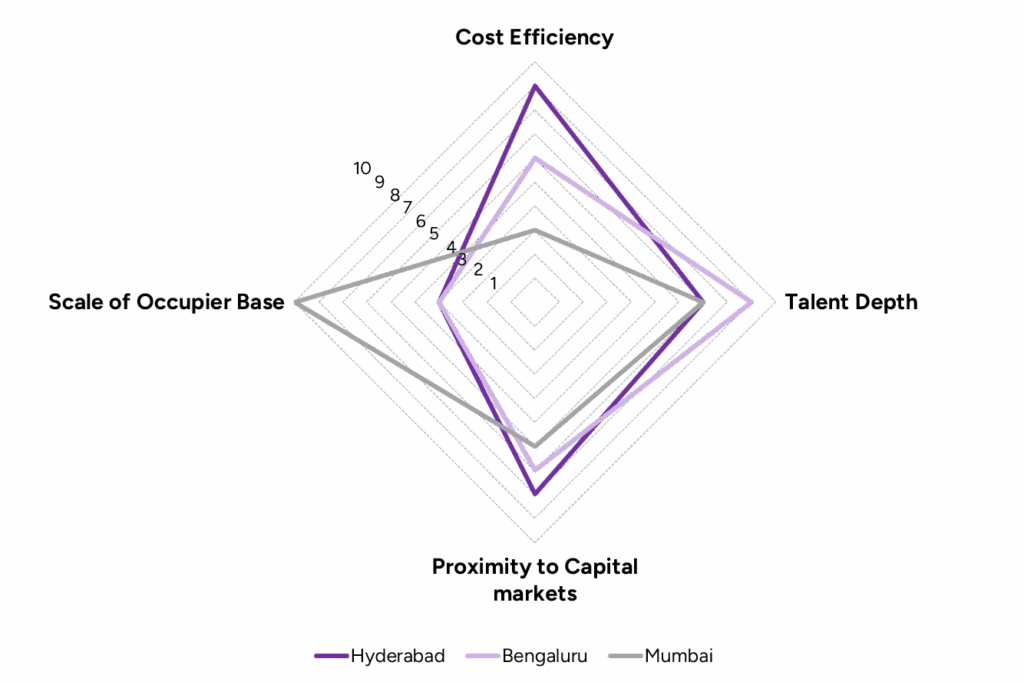
| Factor | Mumbai | Bengaluru | Hyderabad |
| Primary Advantage | Financial ecosystem | Technology talent | Cost-efficient scale |
| Average Grade A Rent | ~₹170-180/sq ft/month | ~₹105-115/sq ft/month | ~₹75-90/sq ft/month |
| Key Occupier Profile | Headquarters, investment banking | GCCs, engineering, AI, analytics | GCCs, technology, operations, risk |
| Talent Strength | Strong financial professionals | Excellent technology talent | Strong and growing technology talent |
| Cost Competitiveness | Lowest | Moderate | High |
| Scalability | Moderate | High | Very High |
Choosing the Right Market
This comparison illustrates that India's BFSI office landscape is not defined by a single market outperforming the others on cost. Rather, it reflects an alignment between specific business functions and the strengths of each location.
Bengaluru continues to strengthen its position as the preferred city for technology-led BFSI functions, supported by a mature digital ecosystem, a deep engineering talent base and an expanding cluster of capability centres that continue to raise the benchmark for GCC operations.
Mumbai remains the default location for functions requiring proximity to financial institutions, regulators and decision-makers. While this is a higher-cost market, the premium is generally understood to reflect strategic value that is not fully captured through cost analysis alone.
Hyderabad has established itself as the market to monitor for large-scale operations, supported by lower real estate costs, an expanding talent pool and a development pipeline of Grade A office space that shows no indication of near-term constraint.
These considerations are not theoretical at the point of executing a lease. Office leasing decisions within BFSI increasingly involve integrated fit-out planning, phased hiring and multi-year space commitments, meaning an accurate city-function match at the outset materially reduces the likelihood of costly rework later, both in real estate expenditure and in the disruption of relocating an already-scaled team.
All three markets are expected to continue expanding rather than one displacing the others. Bengaluru is likely to retain its leadership in technology-driven BFSI functions as digital transformation investment continues to rise. Mumbai will remain central to the country's financial infrastructure, given that its institutional depth is not readily replicable by a lower-cost market.
Hyderabad warrants particular attention over the coming years. As an increasing number of BFSI organisations seek to scale operations and expand digital capabilities without incurring Mumbai or Bengaluru-level occupancy costs, the city's combination of cost efficiency, expanding talent supply and available Grade A inventory positions it to continue gaining share of national BFSI leasing activity, a pattern tracked in detail in Altre's India BFSI Industry: Office Market Insights 2026 report, with the potential to overtake Bengaluru as the second largest BFSI office market in the country.
Mumbai holds the largest share by occupied Grade A stock. Bengaluru follows in second place, and Hyderabad has closed the gap so much that it now holds almost the same share as Bengaluru.
Occupiers in Mumbai are not simply paying for square footage. The city's concentration of regulators, capital markets and corporate headquarters means the rent effectively buys proximity to decision makers, and that keeps both demand and prices elevated even in a costlier market.
Most organisations do not confine themselves to a single city. A common approach is to base headquarters and client-facing work in Mumbai, innovation and digital functions in Bengaluru, and scaled operations in Hyderabad, rather than consolidating everything in one location.
Mumbai draws front office, business-critical roles such as investment banking, treasury, and wealth management. Bengaluru is more closely associated with technology-intensive work, including software engineering, artificial intelligence, analytics and digital banking platforms.
Certain corridors have tightened considerably, pushing rents higher in the process. This is one reason some occupiers planning large, campus-scale expansions are now evaluating Hyderabad more seriously.
An organisation can save roughly 50 to 60% per square foot on average Grade A rents by choosing Hyderabad over Mumbai, though the exact figure depends on the specific micro market and building grade being compared.
Published: September 24, 2026
Discover more insights and expert perspectives on commercial real estate and business growth



Copyright © 2026. All rights reserved.