Contact us
Jun 11, 2026•5 min read
Haryana GCC Policy 2026: What the Incentives Mean for GCC Location Decisions in NCR
Read More
Written by: Aaradhna
Published at: 06/02/26
The corporate floor plate of 1995 and the headquarters being commissioned in 2026 look like buildings from different planets. But put a finance back-office from a Hartford insurance tower next to JPMorgan's new 270 Park Avenue, or compare an early IBM Armonk floor to Google's Bay View, and the buildings barely speak the same language. The desks, the lighting, the layout logic, almost none of it has carried over.
It's not just the buildings alone that changed; along the way, the idea of work has also been quietly rewritten. There was a time when going to the office was a status marker, when working from home meant you were ill, and when creative work was understood to happen in specific buildings and proximity to them was a career strategy. That mental map has been redrawn.
Today's office includes people whose needs, abilities, and expectations were rarely accounted for in buildings from a generation ago. Workspace design is downstream of what work has become and who is doing the work. Office design in 2026 looks the way it does because the nature of work has changed, and so has the workforce doing it.
This analysis draws on Altre's advisory work across enterprise occupiers and GCC clients, alongside three decades of documented shifts in how global organizations brief, build, and use their workspaces. To understand where workspaces are heading next, you have to understand the four eras that have produced where they are now.
While office towers and blocks existed from the late 1800s, it was only during the post-war boom between the 1950s and 1980s that they became universally promulgated. The workspace of this era existed for one purpose: to process work at scale. From administration, back-office finance, sales operations, to early IT and customer service. All happened within the humble cubicles, a concept which itself was less than two decades old at this point.
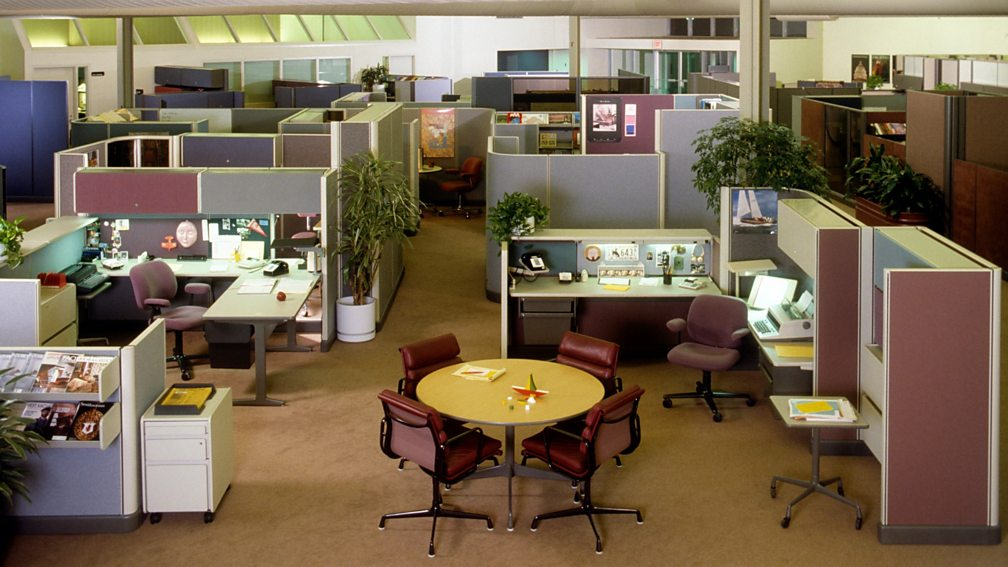
Source: Architectural Digest
Productivity meant throughput, and throughput meant seat density and managerial line of sight. The economics of the office were the economics of cost-per-seat. The buildings reflected that brief. Deep floor plates absorbed thousands of workers per floor. Cubicles ran in long rows, with supervisor cabins ringing the windows so managers could see who was at their desks. Fluorescent ceilings, carpet tile, low-budget partitions. Real estate was procured at the lowest viable cost-per-seat, and the fitout was a procurement exercise rather than a design one. Most floors were interchangeable; a finance back-office in Newark looked roughly the same as a customer service centre in Phoenix.
The building itself carried status in a way that is hard to remember now. Working at IBM Armonk, Procter and Gamble Cincinnati, or a Wall Street tower meant something, and the badge that let you into the building meant something too. The commute was the boundary between home and work, and that boundary was respected, partly because the infrastructure for remote work did not yet exist. A fax machine at home was an executive luxury. The laptop was rare and tethered. You arrived at 9 and left when your manager did. Productivity was something supervisors measured by line of sight, and the cube farm captured in Office Space and Dilbert was an accurate enough portrait of working life for tens of millions of people.
The workforce these buildings were designed for was narrower than today's. Accessibility was treated as code compliance, if it was treated at all. Lactation rooms, gender-neutral facilities, sensory-quiet zones, prayer spaces: the assumption that a workspace should genuinely accommodate the full range of human needs had not yet shaped what got built.
What changed at the end of this era was technological and demographic, as the first wave of technology firms questioned whether the office had to look this way at all.
With the dot-com bubble and the rise of the next generation of tech giants, the brief for offices changed. The workspace was now expected to do something the efficient floor had never been asked to do: attract people. Knowledge work, including engineering, product, marketing, and design, became the centre of gravity for the most ambitious firms.
As recruiting and retaining specialized talent moved into board-level conversation, the office became part of the employer brand.
The buildings reflected this with a confidence that, in hindsight, sometimes tipped into excess in campus developments with cafeterias, gyms, climbing walls, and micro-kitchens. Open plans replaced cubicles as the default. Atriums and glass facades signalled that this was a modern employer. Pixar's Emeryville building was designed by Steve Jobs to engineer collisions between teams. The early Googleplex famously gave employees so many reasons to stay on campus, including free food, free laundry, and nap pods, that working hours quietly extended in ways many workers accepted without naming.
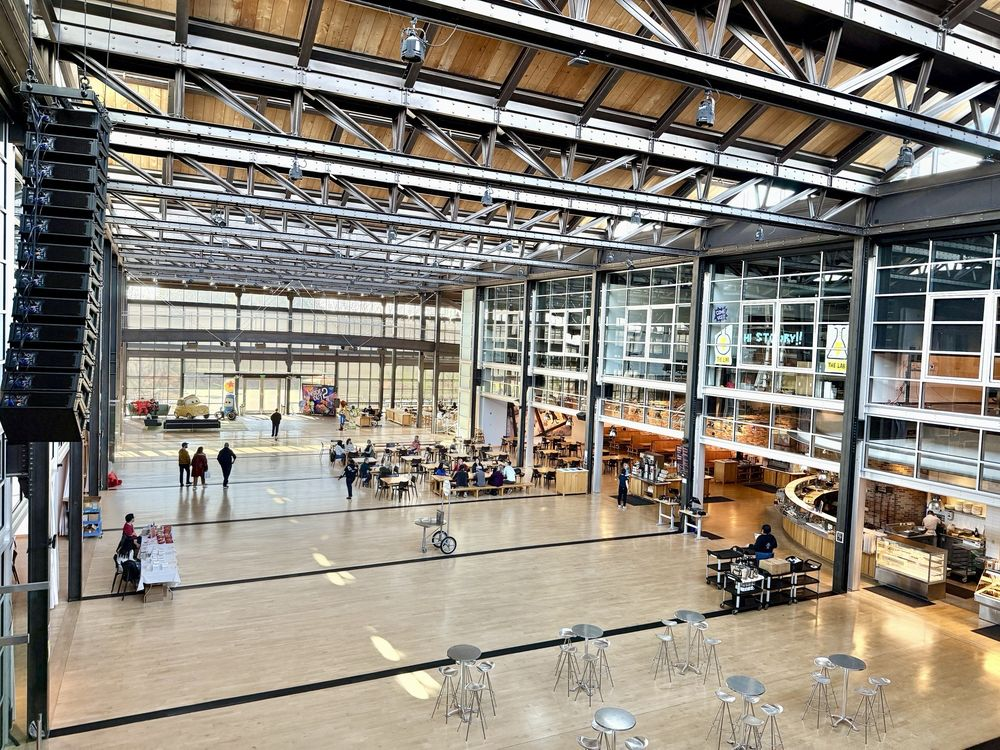
Source: The Business Journals, Pixar's Emeryville Building
The relationship with work began to flip. Where the 1990s office demanded that workers conform to the building, the 2000s campus tried to attract workers by being a place they wanted to be in. Creative work acquired specific geographies: advertising in Soho or Shoreditch, design in Stockholm or Portland, technology in the Bay Area and increasingly Seattle, Austin, and London. People talked about working at IDEO, Pixar, or early Apple the way an earlier generation had talked about working at IBM.
But the open plan showed its limits almost from the beginning. Focus work suffered. Noise and interruption became real productivity problems, and headphones became as essential as the laptop. And while these buildings were more democratic in some ways, with managers sitting on the same floor as junior staff, they were not yet meaningfully inclusive. Accessibility was largely still a compliance concern rather than a design intent.
The recognizable workspaces of this era, including the early Googleplex, Microsoft's expanded Redmond campus, Bloomberg's New York headquarters with its open trading floors and central spiral ramp, Goldman Sachs'200 West Street tower, and the Novartis campus in Basel, set the template for what a modern workplace looked like for nearly two decades.
But as the open-plan always-on phone era began to show its consequences, a new generation entered the workforce and started asking different questions about why and how they wanted to work.
The next brief was more sophisticated. The office now had to support multiple kinds of work happening simultaneously: deep focus, collaboration, video calls, training, and social moments. Employee experience became a measurable retention lever rather than a brand exercise.
Buildings responded with activity-based working zones. Quiet zones, collaboration zones, focus rooms, phone booths, and library floors. Hot-desking emerged in firms with mobile workforces. Technology moved into the design brief in a serious way: huddle rooms, AV-equipped meeting spaces, and immersive telepresence. WELL Building Standard and LEED certifications became standard asks for marquee projects. Sustainability and wellness moved from nice-to-have to expected.
Inclusive workplace design gained real ground in this era. Gender-neutral restrooms became standard, lactation rooms moved from converted closets to properly designed amenities, and prayer and reflection spaces appeared at scale. Sensory-quiet rooms, ramps, accessible workstations, and step-free routes became design defaults rather than afterthoughts.
Then, in March 2020, every office in the world emptied at once.
The pandemic accelerated everything by a decade. Knowledge workers discovered they could do their jobs from kitchen tables, spare bedrooms, and rented houses in mountain towns. Companies discovered the same thing, often reluctantly. Two years later, the return-to-office became one of the most contested topics in modern management. Some firms went fully remote. Some demanded a full return. Most landed somewhere in between, in arrangements that nobody had a name for yet.
This is the era when the implicit contract between worker and workspace was openly renegotiated for the first time in a generation. Status decoupled from presence: senior executives started joining important meetings from their homes. The calendar that let you into the meeting started mattering as much as the badge that let you into the building.
The recognizable workspaces of this era, including Bloomberg's 2017 London headquarters by Foster and Partners, Apple Park in Cupertino, The Edge in Amsterdam, Microsoft's Building 86 renovation, and the post-2020 redesigns at Salesforce, Slack, and Atlassian, each adapted their physical footprints to a hybrid model their workforces had often adopted ahead of them.
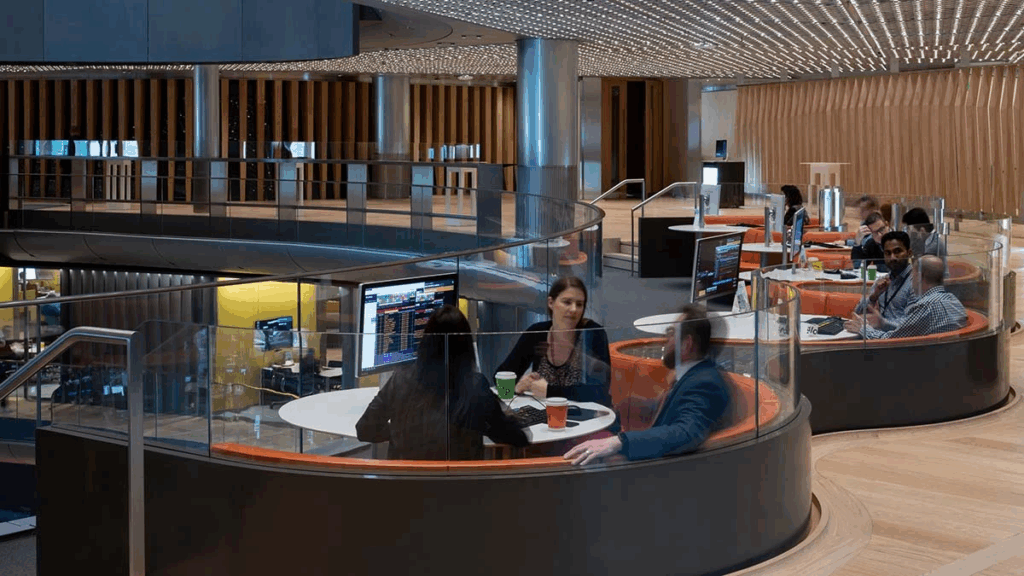
Source: Bloomberg, Bloomberg's London Headquarters
What changed at the end of this era was that organizations stopped trying to recreate the pre-2020 office and started designing for what the office had become: a place you came to for specific work, not a place you went to by default.
The current era is defined by a single shift: the default office template is dead. What replaces it is bespoke to the function the workspace is being asked to perform.
A product engineering centre, a financial trading floor, an AI/ML research lab, and a customer experience hub are doing genuinely different work, and their physical environments are starting to reflect that. R&D centres include prototyping labs, hardware test areas, and quiet engineering pods. Operations hubs prioritize control rooms, compliance-grade segregation, and large training environments. AI/ML centres treat compute access, secure data infrastructure, and collaboration density as core design inputs. Creative studios are designed around iteration and review, not desk count.
This shift is highly visible in GCC office design across India. As Bengaluru's ORR and Hyderabad's Financial District corridors have matured, the GCC brief has evolved from “give us 100,000 sq ft of Grade-A space” to “build us an engineering hub, a data centre adjacency, or a BFSI compliance environment.” The India office leasing market in Q1 2026 recorded 19.2 million sq ft of gross absorption, with green-certified, Grade-A assets commanding 76 to 97% of leasing activity, a direct reflection of occupiers demanding purpose-built environments.
Sustainability has shifted from certification chase to structural input. Embodied carbon, daylight access, water reuse, mass timber construction, and on-site renewables. The conversation has moved from “is this LEED Gold?” to “what is the actual carbon profile of this building over the next 40 years?” Speed-to-occupancy has also become a competitive variable: 16 to 24 week fitouts are now achievable and increasingly expected in the Indian market.
Inclusive design has matured into something integrated rather than additive. The best 2026 workspaces treat accessibility, gender inclusion, neurodiversity, and cultural sensitivity as design inputs from the brief stage rather than retrofits late in the process. The shift is from “we comply” to “the building genuinely works for everyone walking into it,” and the firms doing this well are finding that inclusive workplace design is good design, generally, for the organization as much as for any individual user.
The workspaces defining this era, including Google's Bay View campus in Mountain View with its team neighbourhoods and engineered acoustic and daylight conditions; Apple's expanded engineering footprints in Austin and Munich; Bayer's and Roche's recent pharma R&D expansions in Basel and Leverkusen; and JPMorgan's 270 Park Avenue, the largest all-electric skyscraper in the United States and designed for a hybrid workforce from the ground up, each reads architecturally as a different kind of building, not a generic one.
What changed in this era, more than anything else, is on the supply side. Design and build moved from procurement to advisory. The better firms now ask what the workspace is being built to do, and who it is being built for, before they ask how many square feet it needs.
The next shift is already visible in the buildings being commissioned now.
AI-native workspaces. Design briefs increasingly assume LLM-assisted work, agentic workflows, and ambient AI infrastructure. That changes meeting room density, screen-to-desk ratios, and the role of the desk itself. Some firms are piloting environments designed for human-AI collaboration rather than human-human meetings.
Modular and re-zonable layouts. Organizations are building for the mandate they have and the mandate they do not yet know they will have. Fitouts that can be re-zoned in weeks rather than months are now a real differentiator.
Sustainability as structural. Net-zero operational carbon, mass timber construction, on-site renewable integration, water reuse. The certification race is giving way to actual carbon accounting.
Sensor-instrumented buildings. Occupancy data, utilization analytics, indoor air quality, and acoustic mapping. Buildings increasingly learn from the people using them and adjust.
Inclusive design as default. What is currently an advanced practice will become the baseline. Universal design principles built into every brief, not specified as add-ons. The next generation of workers, broader across every axis than any before, will treat inclusive workplace design as table stakes.
Workspace as urban anchor. The best new offices are being designed to be part of their neighbourhoods rather than isolated from them. Ground floors are opening to public use. The wall between the workplace and the city is becoming porous.
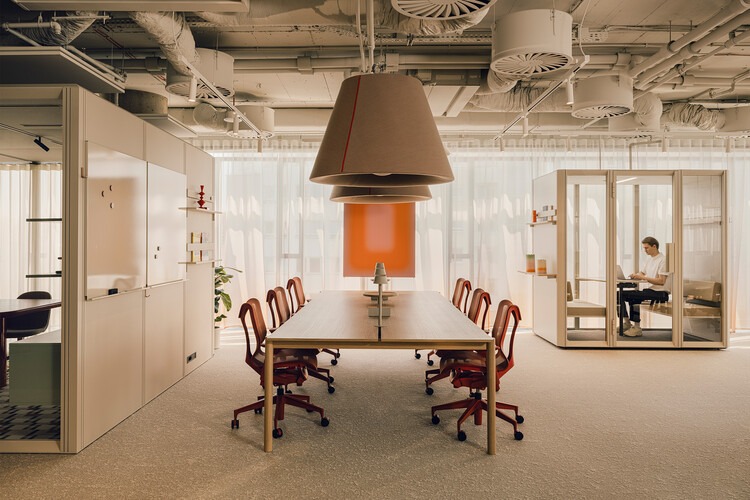
Source: ArchDaily, Adaptable Office Design
The workspace question is no longer “what does a modern office look like?” It is “what does this organization need to do, who is doing it, and what physical environment helps them do it best?”
The workforce in 2026 is broader, more diverse, and holds more options than at any point in the last 30 years. A workspace is competing for the worker's time, not just hosting it. The buildings that succeed will be the ones designed around what work needs and what workers expect, including the worker who navigates the building in a wheelchair, the one who needs a quiet room for focus, the one who needs a lactation room or a prayer space, and the one who simply expects the building to work for them without having to ask.
A leader briefing a design and build partner in 2026 should expect a diagnostic conversation, not a catalogue of finishes. Before the build brief, it is worth mapping which micromarket and city best serve the mandate, using Altre's Business Location Advisory platform. The questions worth asking are about function (what work happens here?), about people (who is doing it, and what do they need?), about phasing (what changes in 24 months?), and about measurement (how will we know the space is helping?).
Altre's Design and Build team works with enterprise occupiers and GCCs across India to design, build, and deliver workspaces from brief to occupancy, typically within 16 to 24 weeks. For a detailed view on briefing, designing, and building workspaces suited to where work is going next, explore Altre's design and build advisory or connect with our team.
Published: June 1, 2026
Discover more insights and expert perspectives on commercial real estate and business growth

Copyright © 2026. All rights reserved.