Contact us
Apr 10, 2026•5 min read
AI vs Traditional Broker Research: Why Speed Matters in CRE
Read More
Written by: Rohan Bhattacharya
Published at: 04/10/26
Commercial real estate and artificial intelligence. Despite the continuing integration of artificial intelligence in various aspects of our work, life, and leisure, CRE and AI seem poles apart. This is perhaps because we still associate real estate in India, not just commercial real estate, with hundreds of calls, messages, brochures, presentations, and unending visits.
That's why we'd like you to meet Aly, India's first AI for commercial real estate.
Aly is a proprietary AI layer built using hundreds of thousands of data points collected from Altre's platform. All of these data points, including over 75 parameters per office building, thousands of Grade A office buildings and over a thousand coworking centres across the country, hundreds of companies and GCCs, talent data per micromarket and city, and more, are all structured within Aly to give you decision-ready answers instantly.
Aly works on a simple principle: speed and accuracy must be optimized in commercial real estate decision-making. Today's decision-makers, real estate leaders, and business heads have more information than before, even though gaps still exist. The challenge now is parsing the dozens of disparate data points that are spread across landlords, operators, and brokers. This data aggregation and curation can take weeks of manual effort before a single decision can be made. A factor made worse by the fact that traditional reconnaissance involves multiple rounds of such data-gathering activities.
To make the process easier and have business leaders instead face structured answers at the start of any commercial real estate transaction, we sought to bring technology to the forefront. By using a RAG model trained on Altre's datasets, we created a highly sophisticated artificial intelligence tool to answer any commercial real estate, consulting, location advisory, or talent query that a decision maker would ask.
Through exhaustive training, we also managed to ensure that the most of the search-to-selection process for office buildings can be done through Aly itself, with barely any need to leave the platform.
Results? Weeks of manual data collection and early analysis, condensed down to a few seconds as Aly analyses your question and gives sophisticated, business-ready answers. Answers that you can use to act immediately.
Here's a good example of what that actually looks like in practice.
Ask almost anyone in the startup ecosystem which Indian city is best for a new tech company, and you'll get the same answer: Bengaluru. It's received wisdom at this point, so embedded in the conversation that most people have stopped questioning it. And they're probably right. But “probably right” and “defensibly correct” are very different things, especially when you're making a location decision that will shape your talent pipeline, your office costs, and your ability to scale for the next several years.
We asked Aly the same question: suggest the best city for my tech startup.

What came back was a structured, multi-dimensional analysis, and we want to walk you through how Aly reasons, not just what it concluded.
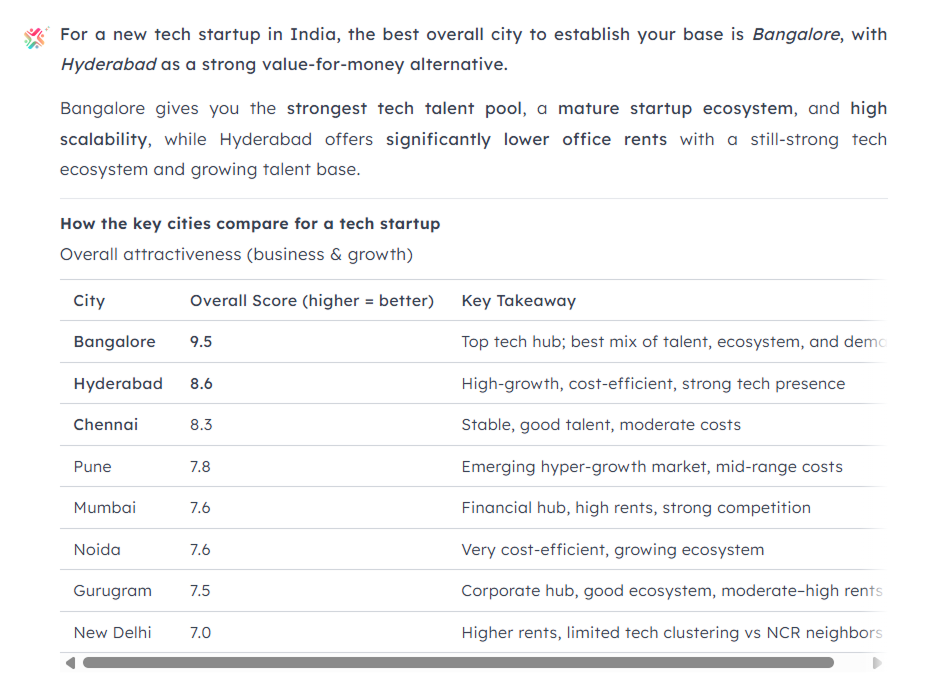
On talent, Aly's data shows Bengaluru commands approximately 26.6% of the tech-relevant workforce nationally. Hyderabad follows at around 18.5%, Chennai at 17.4%. For a tech startup that lives and dies by engineering and product talent, this is the kind of number that's almost impossible to arrive at independently without weeks of research.

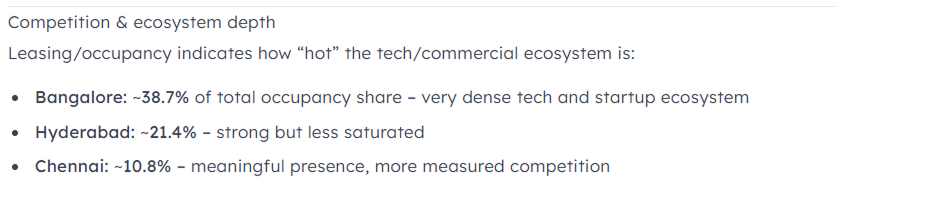
On ecosystem density, Aly looks at leasing and occupancy share as a proxy for how active and competitive a market really is. Bengaluru holds roughly 38.7% of the total occupancy share across the country for tech companies. Investors, accelerators, senior hires, potential partners cluster where the ecosystem is thickest. Hyderabad, at 21.4%, offers a strong but less saturated alternative, which Aly flags as meaningful for a company that wants room to stand out rather than compete in a crowded field from day one.
On scalability, the leasing volume data adds another dimension. Bengaluru leads nationally at 29.88 million square feet, indicating sustained, long-term demand and a real estate market built for growth. Pune and Gurugram show sharp growth in leasing percentage terms, 168% and 61% respectively, which Aly correctly flags as signals for secondary or expansion hubs rather than primary bases.
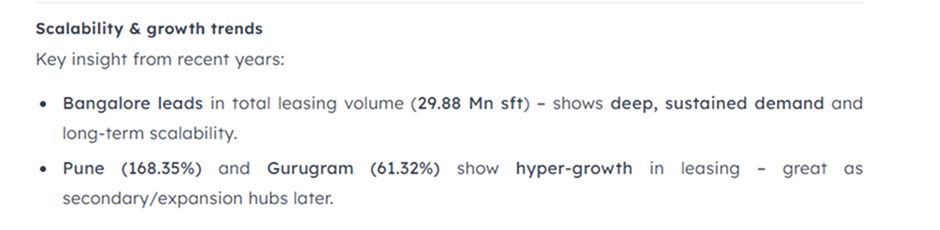
Aly's final recommendation: start in Bengaluru for the best overall business advantages, with Hyderabad as a cost-optimized alternative or future expansion city.
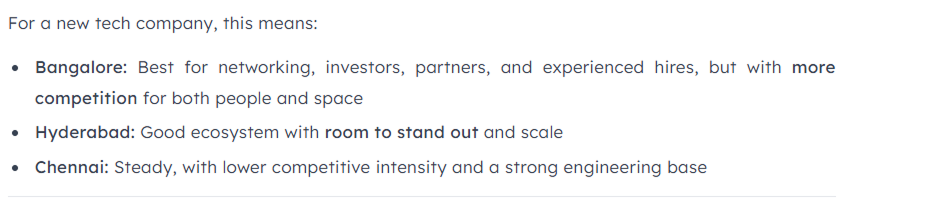
As we said in the beginning, the recommendation isn't new. What's new is the reasoning that sits behind the recommendation, presented in a structured, quantified, and traceable form, and derived from actual market data. The kind of reasoning that you can take into a board meeting, a founder conversation, or a location strategy document and defend without qualification.
That's the difference between knowing something and being able to prove it.
As with other AI advancements worldwide, Aly is also evolving. We are constantly working on multiple methods to improve and enhance Aly's functionality for decision makers and commercial real estate professionals. If you're making a location, leasing, or workplace decision and want answers like these on your specific situation, you can access Aly through Altre's platform or follow Altre on LinkedIn for the latest updates on what Aly can do.

Published: April 10, 2026
Discover more insights and expert perspectives on commercial real estate and business growth

Copyright © 2026. All rights reserved.