
 Contact us
May 4, 2026•5 min read
GCC Bangalore vs Hyderabad: What the Deal Data Actually Tells You About India's Two Dominant GCC Cities
Read More
Written by: Vipasha Sharma
Published at: 04/10/26
A standard broker's market report takes anywhere from five days to two weeks to land in your inbox. In that time, often one of the shortlisted properties has already moved, a competitor has signed, or the vacancy data is stale. This is the quiet cost of traditional research in commercial real estate; not just time lost, but decisions made on yesterday's photograph. AI in commercial real estate changes that equation by not replacing the judgment call, but by eliminating the lag between a question and a credible answer.
Experienced brokers bring something irreplaceable to the table because they know which landlords are motivated, which buildings have hidden issues, and which micromarkets are about to turn. That kind of knowledge is built through years of site visits, relationship calls, and pattern recognition; this simply does not and can not exist in a database. But the process behind getting this deliverable ready for the client's review is slow by design. A broker pulls comparables from memory and contacts, compiles them into a spreadsheet, cross-references a market report that may be weeks old, and sends the client a deck that reflects a snapshot, not the current state. The output is only as current as the last time someone picked up a phone or updated a shared drive. In fast-moving corridors, that lag is a major structural disadvantage.
Consider a scenario where a real estate head needs to understand the current Grade A supply situation in Pune's Hinjewadi corridor before a board presentation. With a traditional process, that means multiple broker calls, follow-up emails, and days and days of waiting. With AI in CRE, it means typing the question in natural language and getting a structured answer in under a minute.
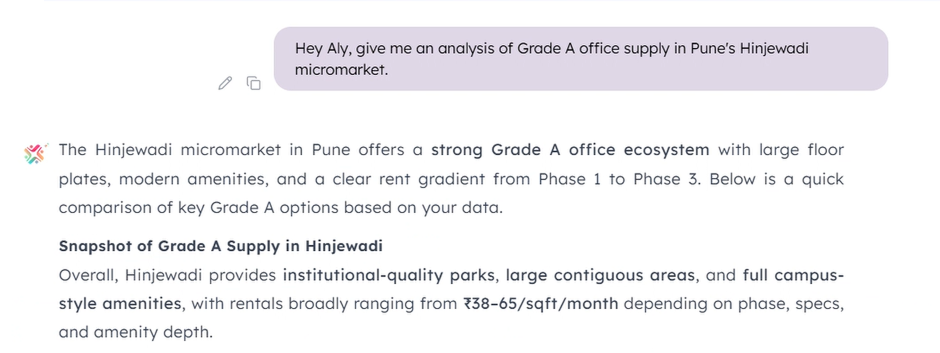
AI tools for real estate pull from a broader set of signals simultaneously, real estate availability, talent market conditions, competitor footprint, infrastructure developments, and process them without the inconsistency that comes from asking multiple brokers the same question.
The compounding effect is significant. When intelligence is faster, decisions happen before the market has already moved. A team evaluating three cities in parallel can get coherent data on all three simultaneously, not sequentially. Speed here is not about efficiency for its own sake; it is about the quality of the decision itself. The longer you wait for basic information, the more variables have already shifted beneath you, making the hidden cost of time bigger.
AI can not replace brokers; however, it equips decision-makers with the intelligence they need before those conversations even begin. Workplace consulting tools like Aly allow decision makers to stop relying on delayed reports and fragmented data. Instead, commercial real estate AI tools like Aly bring clarity and market context to deliver sharper insights, so every broker interaction is more focused, faster, and grounded in facts.

Published: April 10, 2026
Discover more insights and expert perspectives on commercial real estate and business growth

Copyright © 2026. All rights reserved.