
 Contact us
Jun 11, 2026•5 min read
Haryana GCC Policy 2026: What the Incentives Mean for GCC Location Decisions in NCR
Read More
Written by: Aaradhna
Published at: 05/04/26

The data from 2025 and early 2026 does not ask you to choose between India's two dominant GCC cities. It asks you to understand why the smartest global operators are in both, and what that tells you about each city's distinct role.
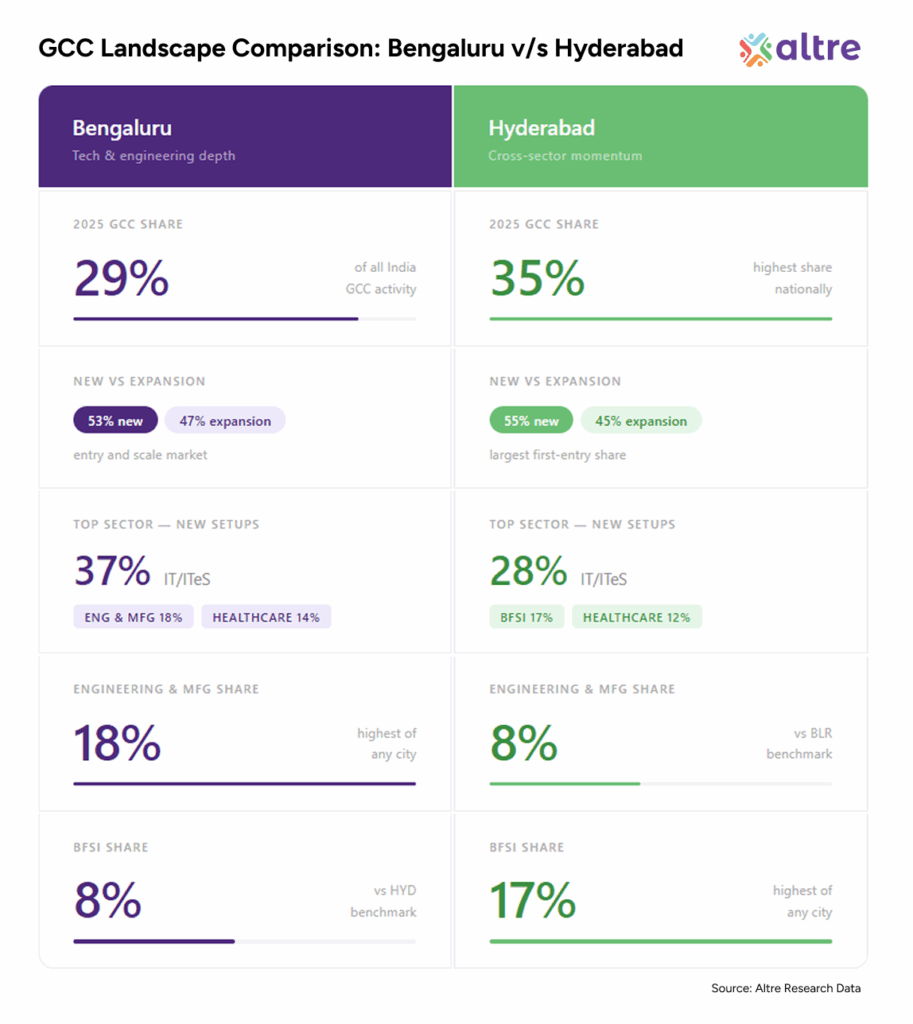
India's GCC market added 170+ setups in 2025, absorbing over 23 million square feet of office space. Two cities absorbed the bulk of that momentum. Hyderabad captured 35% of all GCC activity, the largest share of any city, while Bengaluru held 29%, anchoring the market's deepest concentration of established, large-format capability centres. Together, they accounted for nearly two-thirds of India's GCC activity in 2025, according to the Altre and Inductus GCC Landscape Report 2025 and Altre's Q1 2026 research tracker. That concentration is not an accident. It reflects something more precise: two cities playing genuinely different roles in how global organizations are building in India.
The most telling signal is not which city is growing faster. It is that Apple, McDonald's, and Hartford Financial all have active GCCs in both cities simultaneously. That is not hedging. That is deliberate mandate separation, and understanding what drives it is the real decision a GCC head needs to make.
Bengaluru's GCC story is 25 years in the making, and the 2025 data shows what that maturity looks like in practice. The city runs an almost equal split between new setups (53%) and expansions (47%), which means it is simultaneously absorbing first-time entrants and scaling existing platforms. No other Indian city maintains that balance at this volume.
The deal profile tells the same story. Deloitte took 1.5 million square feet. Blackstone expanded to 450,000 square feet. Apple added 270,000 square feet. Chevron set up a 312,000 square foot engineering and innovation hub. These are not pilot centres; these are permanent, scaled capability anchors. In Q1 2026, Applied Materials committed 806,000 square feet at Whitefield, one of the largest GCC transactions recorded so far this year. Texas Instruments locked in 550,000 square feet for R&D. Airbus expanded to 151,710 square feet.
The industry composition explains why. In Bengaluru, 37% of new GCCs in 2025 were IT/ITeS, and 18% were engineering and manufacturing, the highest engineering share of any city. The Outer Ring Road and Whitefield corridors have become the default address for product engineering, R&D, and deep tech mandates. When IBM opened its Agentic AI Innovation Center at 161,000 square feet in Bengaluru, it was not choosing the city arbitrarily. It was choosing the ecosystem that already held its talent supply chain.
A notable cluster of APAC-headquartered firms landed in Bengaluru in 2025. Japanese manufacturers Nachi, Pioneer, Komatsu, and Toyo all set up engineering GCCs in the city within the same year, a concentration that is less coincidence and more signal. Bengaluru's APAC share stands at 18%, the highest of any major Indian city, and the deal profile skews almost entirely toward engineering and R&D mandates. What this reflects is not a regional preference so much as a new geography discovering an established ecosystem: firms building for the first time outside their home markets, and finding in Bengaluru's supplier networks, engineering talent depth, and peer GCC concentration a ready infrastructure to plug into.
Karnataka's KATALYST framework, which fast-tracks GCC setup and operations, has strengthened the city's policy position without needing to compete on pure cost. Bengaluru does not win on rent. It wins on depth.
Hyderabad's position in 2025 is the more interesting story precisely because it is less expected. The city captured 35% of all GCC activity, ahead of Bengaluru, and 38% of all first-time setups nationally. That new-entry skew is the defining characteristic of Hyderabad's current market position.
The industry mix is notably broader than any single sector story can explain. IT/ITeS leads at 28%, but BFSI holds 17%, healthcare 12%, retail and FMCG 12%, and a long tail of sectors like energy, telecom, aviation, hospitality, and gaming that have seen limited GCC activity elsewhere. Amgen took 500,000 square feet. HCA Healthcare expanded to 428,000 square feet. McDonald's built a 200,000 square foot Global Business Services and Technology Centre. Netflix, Marriott, Heineken, and L'Oreal all opened new GCCs in 2025.
What connects these otherwise unrelated industries is a shared underlying need: access to talent for technology, data, and operations roles. A pharma firm's GCC and a retail firm's GCC are both, at their core, building tech teams. Hyderabad's talent pipeline for these roles is deep and cost-competitive, and Telangana's single-window facilitation has reduced the administrative friction that typically slows first-time India entrants. The result is a city absorbing first-mover mandates across sectors simultaneously, not because it dominates any one of them, but because it clears the bar on fundamentals every new entrant is evaluating.
Q1 2026 has reinforced this pattern sharply. Charles Schwab leased 345,000 square feet at Phoenix Equinox in Gachibowli, its first GCC outside the United States. LPL Financial took 300,000 square feet at the Financial District, also its first India centre. Sanofi expanded its Hyderabad GCC to 270,000 square feet, scaling headcount toward 4,500 employees. UBS opened a new office housing 3,000 people. The city's BFSI absorption velocity in early 2026 alone would constitute a significant annual total for most other markets.
What enables this breadth is a combination of cost-effective micromarkets, available large-format Grade-A inventory, and a city that is genuinely accessible, both physically and administratively. HITEC City and the Financial District corridor can absorb campus-scale demand at cost points that remain competitive against comparable Bengaluru addresses. Telangana's single-window facilitation and faster clearances have consistently reduced setup friction for first-time entrants. Hyderabad wins on speed-to-market and sector accessibility.
The firms operating in both cities are not splitting locations arbitrarily. Apple has its product engineering and R&D weight in Bengaluru; its technology operations GCC sits in Hyderabad. The mandates are structurally different. Bengaluru holds the deeper, longer-tenure capability. Hyderabad holds the operationally agile, faster-to-stand-up centre.
Of all BFSI GCCs set up across India in 2025, 42% landed in Hyderabad, the highest concentration of any city. For consulting and research, that share rises to 50%. Engineering and manufacturing split more evenly but lean toward Bengaluru. Deep tech and product R&D clusters overwhelmingly in Bengaluru. Healthcare, notably, splits almost evenly between the two: 37% Bengaluru, 37% Hyderabad.
This is not a marginal pattern. It reflects a structural reality that the GCC ecosystem in India has matured enough to support mandate-specific city selection rather than single-city bets.
The Bengaluru vs. Hyderabad question is increasingly the wrong frame. The more productive question is: what are we building, and which city's ecosystem accelerates that mandate?
If the mandate is deep product engineering, R&D, or AI/data platform development, and if the GCC will need to recruit heavily from a mature, established tech talent pool, Bengaluru's depth compounds over time. The city's installed base of engineering talent, supplier networks, and co-located peer GCCs creates network effects that are difficult to replicate quickly elsewhere.
If the mandate is a BFSI technology hub, a global operations centre, or a multi-function GCC that needs to go live quickly across several verticals, Hyderabad's combination of available Grade-A supply, cost efficiency, and Telangana's facilitation infrastructure makes it the lower-friction entry point. The 2025 and early 2026 data show that first-time entrants are consistently choosing Hyderabad to prove the India model before committing to deeper infrastructure.
The two-city model that Apple, Deloitte, and McDonald's are running is not a sign that the location decision is complex. It is a sign that India's GCC market has matured to the point where city selection is a function of strategy, not a real estate decision.
For a detailed view of micro-market dynamics, lease benchmarks, and GCC location strategy in Bengaluru and Hyderabad, explore Altre's Business Location Advisory platform or read the full Altre and Inductus GCC Landscape Report 2025.
Which city is better for a GCC in India, Bangalore or Hyderabad?
Neither is universally better. Bengaluru is stronger for deep product engineering, R&D, AI, and mandates requiring a mature, established talent ecosystem. Hyderabad is stronger for BFSI technology hubs, global operations centres, and first-time India entrants who need speed-to-market and cost efficiency. Many large GCCs, including Apple, McDonald's, and Deloitte, operate in both cities simultaneously with different mandates in each.
What percentage of GCC activity did Bangalore and Hyderabad capture in 2025?
According to the Altre and Inductus GCC Landscape Report 2025, Hyderabad captured 35% of all GCC activity in India in 2025, while Bengaluru held 29%. Together, the two cities accounted for nearly two-thirds of India's GCC setups and expansions.
Which city is better for a BFSI GCC in India?
Hyderabad leads for BFSI GCCs. In 2025, 42% of all BFSI GCCs set up across India landed in Hyderabad, the highest concentration of any city. Q1 2026 reinforced this with Charles Schwab, LPL Financial, and UBS all committing large-format space in Hyderabad's Financial District and Gachibowli corridors.
How do GCC office rents compare between Bangalore and Hyderabad?
Hyderabad's HITEC City and Financial District corridors offer Grade-A office space at cost points that remain competitive against comparable Bengaluru addresses. Bengaluru's Outer Ring Road and Whitefield corridors command premium rents but offer the deepest engineering talent concentration. For current rent benchmarks by micro-market, see Altre's Business Location Advisory platform.
What is Karnataka's KATALYST framework for GCCs?
KATALYST is Karnataka's policy framework designed to fast-track GCC setup and operations in Bengaluru. It provides streamlined approvals and operational support, strengthening the city's position for engineering, R&D, and deep-tech GCC mandates without competing primarily on cost.
What industries are setting up GCCs in Hyderabad?
Hyderabad's GCC industry mix is notably diverse. IT/ITeS leads at 28%, followed by BFSI (17%), healthcare (12%), and retail and FMCG (12%). Energy, telecom, aviation, hospitality, and gaming round out the long tail. Companies that opened GCCs in Hyderabad in 2025 include Netflix, Marriott, Heineken, L'Oreal, Amgen, and HCA Healthcare.
Source: Altre and Inductus GCC Landscape Report 2025; Altre Research Q1 2026 tracker. Data based on Altre's proprietary tracking of 3,600+ commercial properties and 1,300+ coworking and managed spaces across India.
Published: May 4, 2026
Discover more insights and expert perspectives on commercial real estate and business growth


Copyright © 2026. All rights reserved.