Contact us
Apr 28, 2026•5 min read
Singapore Office Market 2026: What You Should Know
Read More
Written by: Rohan Bhattacharya
Published at: 03/10/26
India's Global Capability Centre (GCC) ecosystem has evolved into a strategic global capability engine, with Indian centres now deeply embedded in enterprise decision-making, innovation, and product ownership. The year 2025 marked a scale-up moment for GCCs, not merely in numbers, but in the nature of work, industries participating, and the strategic confidence global headquarters place in Indian operations.
The past year underscored a fundamental shift in how global enterprises view India within their operating models. The near-even split between new GCC establishments and expansions reflected this confidence, signalling that India now serves both as a first-entry market for new global captives and a preferred destination for deepening high-value mandates. More importantly, the nature of work continued to evolve, moving decisively toward AI and data platforms, cybersecurity, product engineering, and enterprise analytics. All of these changes cement India's role as a global capability anchor rather than a peripheral delivery hub.
From Support Centres to Strategic Hubs
Across industries, the most defining change is the movement of GCCs up the value chain. Functions once limited to transactional support—such as finance processing, IT maintenance, and reporting, have been replaced by ownership of core platforms and global mandates. In 2025, GCCs in India increasingly led AI and data platforms, cybersecurity operations, cloud engineering, enterprise analytics, and product development. As teams expand into AI engineering, cybersecurity, and analytics roles, office space strategy for GCCs increasingly prioritizes proximity to specialized talent clusters.
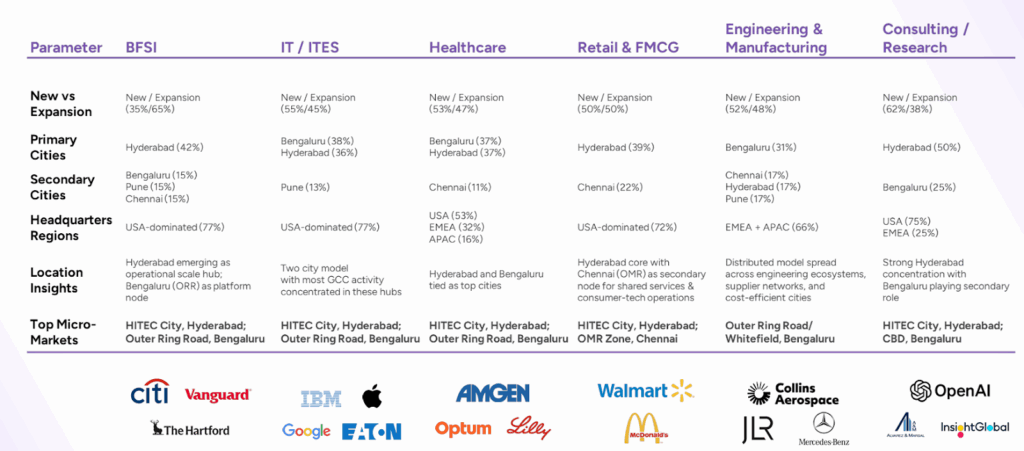
Image: GCCs in 2025 – Industry wise trends
IT & ITeS: Entry Point, Now Product and Platform Led
The IT and ITeS sector continues to anchor India's GCC ecosystem, remaining the primary entry point for global firms. New centres are no longer designed as support extensions but as platform and product hubs, owning global digital systems rather than maintaining them.
Demand has shifted toward full-stack developers, data engineers, AI specialists, cloud architects, and cybersecurity professionals, reflecting India's growing role as a global technology backbone. Bengaluru continues to offer unmatched depth in advanced tech talent, while Hyderabad has emerged as a strong alternative, combining scale, cost efficiency, and speed of execution.

BFSI: A Mature, Expansion-Led GCC Model
The BFSI sector continues to follow a distinctly expansion-led growth path. In 2025, the bulk of BFSI GCC activity was driven by the scaling of existing centres rather than fresh market entry, reflecting the sector's maturity and deep-rooted confidence in India. These GCCs are increasingly anchoring high-value functions such as risk and advanced analytics, fraud detection, regulatory technology, cybersecurity, and digital banking platforms.
Hyderabad has emerged as the leading growth engine for BFSI GCC expansion, accounting for the largest share of incremental capacity additions, followed by Bengaluru, Pune, and Chennai.

Engineering & Manufacturing: GCCs as Global ER&D Engines
Engineering and manufacturing GCCs represent a critical dimension of India's evolving GCC landscape. These centres are increasingly positioned as global engineering research and development hubs, supporting advanced manufacturing, digital twins, industrial IoT, and supply-chain analytics.
Unlike technology and BFSI, this sector shows a more diversified headquarters mix, with strong participation from US, European, and Asia-Pacific firms. Bengaluru has emerged as key hubs for engineering-led GCCs, while Chennai, Hyderabad and Pune plays a complementary role.

Healthcare & Life Sciences: Expanding Beyond Compliance
Healthcare and life sciences GCCs are undergoing a notable transformation. Historically anchored around compliance, clinical data management, and shared services, these centres are now expanding into innovation-driven mandates.
Indian healthcare GCCs increasingly support health-tech platforms, advanced analytics, AI-driven diagnostics, and global clinical research operations. Bengaluru and Hyderabad have emerged as the dominant hub for healthcare GCCs, supported by its life sciences ecosystem, talent availability, and proactive state facilitation.

Retail, FMCG, and Consulting: Knowledge-Centric GCCs
Retail, FMCG, and consulting GCCs, reflect a shift toward knowledge-centric operations. These centres typically operate with lean, high-skilled teams embedded within global strategy, analytics, and transformation functions.
Consulting and research GCCs are particularly new-setup driven, signalling India's rising role as a global knowledge and decision-support hub rather than a back-office destination.


Talent Transformation Across Industries
Across all industries, talent patterns have shifted decisively. Demand has moved away from support-heavy roles toward high-value digital, analytical, and product-led positions. GCCs are increasingly integrated with global teams, and firms are experimenting with Tier-2 cities to improve retention, resilience, and access to distributed talent pools.
Talent strategy, location selection, and workspace models are now tightly interconnected decisions. Many firms are also exploring managed office solutions for GCC teams to enable faster expansion without committing to long-term traditional leases.
What the Next Phase of GCC Growth Will Look Like
As GCCs deepen their strategic role within global enterprises, location advisory for Global Capability Centres has become critical for balancing talent availability, real estate supply, and long-term expansion needs.
Looking ahead, the next phase of GCC growth in India will be shaped by industry-specific depth, execution capability, and integration with global business strategy. GCCs will be required to operate as true extensions of global headquarters, owning outcomes, not just processes. Increasingly, firms are also leveraging AI-powered workspace advisory tools to evaluate cities, talent pools, and real estate supply before establishing new GCC operations.
This will demand sharper location strategies, sustained talent investments, and operating models that balance speed, resilience, and scale.

Published: March 10, 2026
Discover more insights and expert perspectives on commercial real estate and business growth

Copyright © 2026. All rights reserved.