Contact us
Oct 9, 2026•5 min read
India's Position in the Global BFSI Office Market: GCCs, Growth and Outlook
Read More
Written by: Vidushi Kajla
Published at: 09/26/26

India's Banking, Financial Services and Insurance (BFSI) sector has been one of the country's largest occupiers of Grade A office space. For many years, this demand came through incremental expansion. Global financial institutions added space floor by floor as teams grew, often across several buildings and micro-markets within the same city. Findings from Altre's India BFSI Industry Report 2026 show that this approach is now giving way to a very different model.
That pattern is now changing. India's top 60+ BFSI occupiers, most of them global financial institutions, together hold close to 75 MSF of GCC and corporate office space across Mumbai, Bengaluru, Hyderabad, Chennai, Pune and Delhi NCR. A growing share of their demand is coming through large-format office leasing, where a single transaction of 100,000 sq ft or more covers an entire building, several contiguous floors or a dedicated campus. These deals now make up 23% of all transactions by this group.
The wider market has grown at the same time. BFSI office absorption rose from 12.5 MSF in 2023 to 13.2 MSF in 2024 and 15.0 MSF in 2025, in line with the broader momentum tracked in India Office Leasing Landscape H1 2026. Much of that growth came from a small number of global banks and financial services GCCs, which means their leasing decisions influence the market well beyond their own portfolios.
This blog examines what is driving the move towards large-format office leasing, which cities are seeing it most, and what it means for occupiers and developers of Grade A office space.
The transaction data for these occupiers reveals a clear gap between the number of deals signed and the amount of space they represent.
Deals under 5,000 sq ft are the most common, accounting for 32% of all transactions. Together, however, they add up to less than 1 MSF. Most of these are smaller corporate offices, client suites or regional hubs that support a firm's main campus rather than replace it.
Deals above 100,000 sq ft make up 23% of transactions but account for most of the space absorbed. Mid-sized deals of 50,000 to 100,000 sq ft are relatively rare, at just 8% of the total.
This means deal volume alone says little about where BFSI office space demand is heading. A single 400,000 sq ft campus lease can outweigh a full year of small transactions in the same city.
The space itself is also held by a few firms. The five largest occupiers, mostly global banks, account for 54% of all tracked BFSI office space. When even one of them consolidates, the effect on vacancy and rents in that micro-market can be significant.
Changes in both demand and supply have made large-format office leasing the preferred choice for global BFSI firms expanding in India.
India has more than 180 BFSI Global Capability Centres, employing over 550,000 people. Many began with transaction processing and back-office support. Today, they deliver software engineering, AI and machine learning, cybersecurity, fraud analytics, risk modelling and regulatory compliance for their parent institutions.
This kind of work relies on teams collaborating closely, and these teams tend to grow quickly once they are in place. Both needs are best served by GCC office leasing at campus scale, where teams can sit together and firms can take more space in the same development as they grow.
Over the years, many global banks built up scattered offshore units, whether through acquisitions or because different business lines chose their own locations. Many are now bringing these units together into a single centre of excellence for each function. For corporate real estate teams, this usually means exiting several smaller leases in favour of one large commitment.
None of this would be possible without the right supply. Over the past decade, developers in Bengaluru, Hyderabad, Pune and Chennai have built a strong pipeline of Grade A business parks and integrated campuses. Occupiers looking for 200,000 to 500,000 sq ft of contiguous space in these cities now have real options, which was not always true in earlier cycles.
A single campus is simpler to manage. Security, IT infrastructure, facilities management and employee services can all run under one framework. Fit-out also becomes more efficient, because the workplace is designed and delivered once to the parent firm's global standards, instead of being repeated across sites with different floor plates and specifications. Over the lease term, this consistency is especially valuable for global institutions with strict brand, information security and compliance requirements.
Hybrid working has added another factor. With employees expected in the office for part of the week, firms are paying closer attention to workplace quality, including collaboration spaces, food and wellness facilities and access to public transport. Office campus leasing makes these far easier to provide than a set of scattered floors.
The extent of large-format leasing differs widely between cities. The share of deals above 100,000 sq ft closely follows rent levels, the availability of large contiguous space, and the functions global firms tend to place in each market.
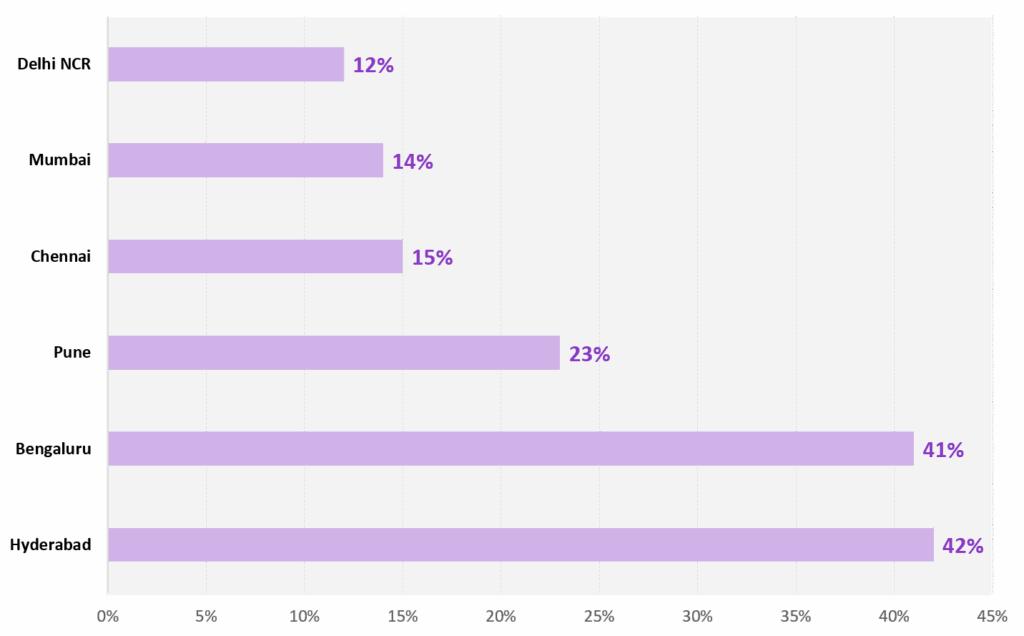
City wise share of large-format BFSI Office space occupied
Hyderabad has the highest share of large-format office leasing among India's major BFSI markets, at 42%.
Hyderabad attracted 40% of India's BFSI GCC demand in H1 2026, more than any other market. Most of this activity is concentrated in the IT Corridor and the Extended IT Corridor, which together hold around 15 MSF of BFSI space. With average rents of about ₹85 per sq ft per month, global firms can expand at scale while keeping occupancy costs well below those in premium markets.
Bengaluru is close behind at 41%. The Outer Ring Road (ORR) holds around 10.8 MSF of BFSI space, or ~60% of the city's total. ORR rents of ₹95 to ₹150 per sq ft are higher than Hyderabad's, but occupiers are willing to pay more for access to the city's engineering, AI and analytics talent. Large-format office leasing allows them to bring that talent together in one place.
Large deals account for 20% of transactions in Pune and 15% in Chennai, and both cities have built a steady base of mid- to large-scale campus operations. Kharadi has become Pune's preferred BFSI growth corridor, with around 4.0 MSF, while Radial Road is home to Chennai's largest campus concentration at about 4.8 MSF. Both markets are well suited to banking operations, asset servicing and technology delivery centres.
Mumbai and Delhi NCR follow a different pattern. Deals under 50,000 sq ft account for 75% of transactions by top occupiers in Mumbai and 78% in Delhi NCR.
This does not signal weaker demand. It reflects the functions global firms choose to place in these cities. Mumbai typically hosts a firm's India headquarters along with its investment banking, treasury and wealth management teams, all of which benefit from being close to clients, regulators and the capital markets. Delhi NCR plays a similar role for leadership teams, corporate functions, consulting and regulatory engagement.
Cost and supply also play a part. Rents in Mumbai's BKC and CBD range from ₹300 to ₹550 per sq ft, and large contiguous floor plates are hard to find. At these rents, a campus of several hundred thousand sq ft rarely makes sense. Most firms therefore keep premium corporate office space in these cities and base their larger operations elsewhere.
For occupiers, large-format office leasing requires more lead time. Finding and securing contiguous space in a preferred micro-market can take 12 to 24 months, so terms such as expansion options, rights of first refusal on adjacent floors and phased handovers are best agreed at the start. Firms can also benefit from planning their India portfolio as a whole, for example by pairing a corporate office in Mumbai or Gurugram with a larger campus in Hyderabad, Bengaluru or Pune.
For developers, steady demand from BFSI GCCs supports continued investment in large Grade A campuses that can house a single occupier with several thousand employees. Large floor plates, room to expand, strong ESG credentials and good transit links will set the best projects apart. At the same time, premium towers in Mumbai and Delhi NCR should continue to attract corporate offices that need a prominent address.
The shift towards large-format deals is expected to continue. GCC mandates are moving towards higher-value work, global banks are still consolidating their offshore operations, and India's GCC base is projected to grow from around 2,000+ centres in 2026 to more than 2,400 by 2030.
A few factors could affect the pace. Global interest rate cycles influence how quickly banks approve expansion budgets, and advances in AI may reduce the number of seats some teams need. Data localisation rules could also shape which functions firms choose to move to India.
Overall, BFSI office demand in India will increasingly depend on the role each location plays within a firm's operating model. Established financial centres will continue to host headquarters and client-facing teams, while large campuses in Hyderabad, Bengaluru and Pune take on most of the growth in technology and operations. Detailed city-level data on rents, micro-markets and top occupiers is available in the full India BFSI Industry Report 2026.
Published: October 9, 2026
Discover more insights and expert perspectives on commercial real estate and business growth

Copyright © 2026. All rights reserved.