Contact us
Oct 9, 2026•5 min read
India's Position in the Global BFSI Office Market: GCCs, Growth and Outlook
Read More
Written by: Vidushi Kajla
Published at: 04/28/26
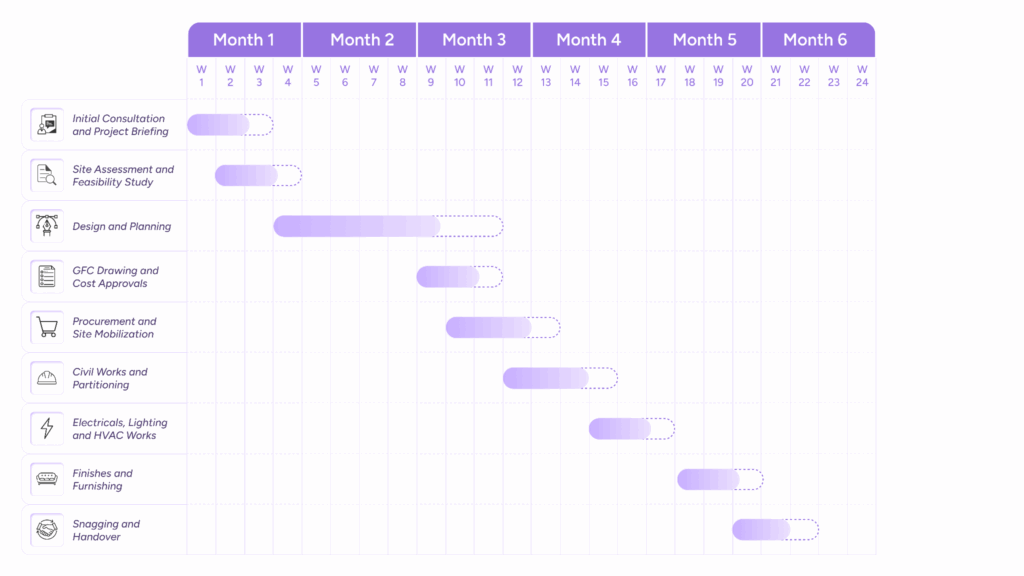
Planning an office fitout in India requires a clear understanding of timelines, as project duration directly impacts cost, operations, and occupancy planning. A typical office fitout in India takes approximately 16–20 weeks (4–5 months) from initial briefing to final handover. While this range provides a useful benchmark, the process is not strictly sequential. Multiple stages overlap in practice to optimise timelines, and effective coordination across these parallel activities is critical for timely delivery.
This article outlines each stage of the fitout lifecycle, along with realistic timelines, responsibilities, and key considerations.
Office fitout refers to the process of transforming a raw or semi-finished commercial space into a fully functional and operational workplace that aligns with an organisation's business needs, brand identity, and employee requirements.
Whether it is an interior fitout for a startup's first headquarters or a commercial fitout for a large enterprise relocating across cities, the scope and complexity of the work varies significantly depending on the condition of the space at the time of lease handover.
Commercial office spaces are typically leased in one of three formats:
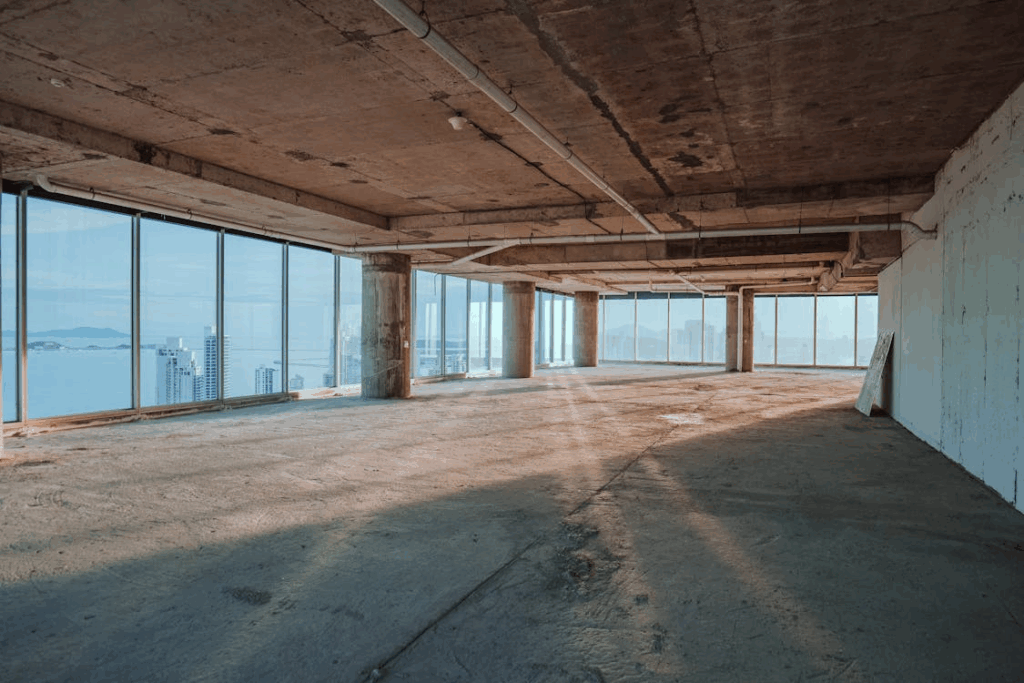
For the purpose of this timeline assessment, the project has been evaluated under the Shell & Core condition. This reflects a baseline scenario where all interior works, building services, and fitouts are to be executed from the ground up, allowing for a comprehensive understanding of the full project scope and duration. For organisations exploring a more structured delivery model, Altre's conventional office offering provides a defined scope and timeline from day one.
Note: The timelines below reflect standard industry benchmarks across fitout projects in India and are not specific to Altre's delivery model.
The fitout process follows a structured sequence of stages, each with defined responsibilities and typical durations. While the overall structure of the project remains fixed, individual stages frequently overlap to optimise the programme. The sections below walk through each stage in order.
The fitout process begins with defining the project brief. This stage establishes the foundation for all subsequent activities and requires close collaboration between the client and the contractor.
Key inputs include headcount projections, departmental requirements, spatial planning preferences, and functional needs such as meeting rooms, collaboration spaces, cabins, and support areas. Technical requirements such as IT infrastructure, security systems, and audio-visual setups are also discussed.
The contractor translates these inputs into a structured scope of work, outlining spatial requirements, preliminary layouts, and indicative specifications.
Following the project brief, a detailed site assessment is conducted to evaluate feasibility. This involves verifying site dimensions, assessing existing building services such as HVAC and electrical capacity, and identifying structural constraints. Fire safety systems, emergency exits, and compliance requirements are also reviewed to ensure alignment with local regulations.
The feasibility study acts as a validation step, ensuring that the proposed design intent can be implemented within the physical and regulatory constraints of the building. Early identification of limitations helps avoid cost-intensive redesigns during execution.
The contractor leads the site assessment and feasibility analysis, with inputs from building management where required, while the client reviews and validates key constraints and implications.
Design development is the most time-intensive phase and plays a critical role in determining both the quality and efficiency of execution. The process typically progresses through multiple stages:
This stage involves multiple iterations and stakeholder reviews to ensure alignment across functional, aesthetic, and technical requirements. Adequate time allocation for design is essential, as changes introduced during construction are significantly more disruptive and expensive.
In practice, this phase often overlaps with the initiation of GFC drawings. While final design elements are being refined, technical documentation and preliminary approvals may begin in parallel to optimise timelines.
“Good for Construction” (GFC) drawings represent the finalised and approved design set used for execution.
This stage includes detailed technical drawings covering all aspects of the project, along with a comprehensive cost breakdown. The client reviews and approves both the design and the commercial proposal before construction begins.
Given the overlap with the design phase, certain approvals may be initiated before full technical design closure. While this approach reduces overall timelines, it requires careful coordination to ensure consistency between approved drawings and final execution drawings.
Procurement and mobilisation represent the transition from planning to execution. This stage involves sourcing materials, coordinating logistics, and preparing the site for construction. Materials such as gypsum boards, glass partitions, electrical components, and finishes are sourced, while long-lead items such as specialised furniture or imported fixtures are prioritised.
Procurement planning often begins during the design phase, particularly for items with extended lead times. Early ordering helps avoid delays but must be balanced against the risk of design changes.
Site mobilisation includes setting up temporary infrastructure, coordinating with building management, and establishing safety protocols. This stage frequently overlaps with early construction activities, particularly in larger fitout projects where work can be phased across different areas.
Civil works mark the beginning of physical transformation on site. Drywall partitions are installed to define spatial layouts, electrical conduits are integrated within partition systems, and door frames are installed.
This phase often overlaps with ongoing procurement, as materials continue to arrive in stages while construction progresses. Effective coordination between supply chains and site teams is essential to maintain workflow continuity. By the end of this stage, the spatial configuration of the office becomes clearly visible, providing a tangible sense of the final layout.
Following civil work, specialised subcontractors execute electrical, data, and HVAC installations, while the contractor ensures coordination and quality control across systems. This includes power distribution, lighting installation, data cabling, and HVAC modifications. Depending on project scale, these activities may be executed in parallel across different zones, particularly where civil works are completed in phases.
Testing and validation form a critical part of this stage, ensuring that all systems function as intended before finishing works begin.
The finishing stage brings together all visible elements of the office. Finishing, painting, flooring, joinery, and furniture installation are completed, along with glass partitions and branding elements. By this stage, the office appears complete in both form and function. Coordination remains important, as minor overlaps with system testing or pending installations may still occur.
The final stage involves detailed inspection and rectification of defects. All components, including electrical systems, finishes, and fixtures, are reviewed to identify and address any issues. The contractor completes necessary corrections before final handover.
Typical Timelines for Various Office Sizes
| Office Type | Size | Timeline | Details |
| Small Office | <5,000 sq ft | 12–14 weeks | Smaller office fitouts are typically completed faster due to limited scope, fewer partitions, and simpler service requirements and quicker decision-making. With efficient planning and minimal design complexity, these projects can be delivered within a relatively short timeline. |
| Medium Office | 5,000–20,000 sq ft | 16–20 weeks | Medium-sized offices represent the most common project scale, particularly for GCCs and corporate occupiers. These projects involve a balanced mix of open workspaces, meeting rooms, and support areas, requiring moderate coordination across design and execution stages. The timeline reflects standard complexity with typical approval and procurement cycles. |
| Large Office | 20,000–50,000 sq ft | 20–24 weeks | Large office projects require extended timelines due to increased scale, higher material volumes, and more complex coordination across multiple teams and workstreams. Execution is often phased across zones, and design detailing is more intensive. As a result, project management and sequencing play a critical role in maintaining timelines. |
| Sustainable / Green Certified Office | 20,000–50,000 sq ft | 24–28 weeks | Offices targeting sustainability certifications require additional time due to stricter material selection, documentation, and compliance processes. Each component must meet defined environmental standards, and verification procedures extend both design and execution timelines. As a result, these projects typically take longer than conventional fitouts. |
For specialist formats, timelines vary based on design complexity and procurement requirements. Built-to-suit and managed offices typically require 20–26 weeks, as they involve bespoke programming, longer approval cycles, and close coordination with building developers or landlords. Open layout and modern layout offices generally fall within the standard timeline for their size bracket, as the design simplicity in these formats can offset coordination complexity. Japanese and Scandinavian-inspired layouts, which emphasise specific material palettes, natural finishes, and craftsmanship detailing, may add 2–4 weeks to procurement depending on the availability of materials through local suppliers.
Project complexity, design detailing, and approval requirements influence the final timeline within these ranges.
Even with structured planning frameworks in place, project timelines remain vulnerable to a range of execution-stage risks. Procurement delays, particularly for specialised or imported materials, can significantly disrupt schedules if not anticipated through early vendor alignment and buffer planning. Stakeholder management is another critical factor; misalignment between clients, consultants, contractors, and subcontractors often leads to decision lags, coordination gaps, and potential rework.
Delays in obtaining statutory approvals and regulatory clearances can further stall progress, especially in projects with complex compliance requirements. Additionally, design changes during execution, commonly arising from evolving requirements or insufficient early-stage detailing, contribute to scope creep, impacting both timelines and costs across multiple workstreams. External disruptions classified under force majeure, such as extreme weather events, natural disasters, or unforeseen site conditions, also pose risks to project continuity.
To mitigate these challenges, a proactive approach to risk management anchored in early-stage planning, clear stakeholder alignment, procurement foresight, and robust contingency frameworks is essential for maintaining project timelines and delivery efficiency.
For a CFO or operations head, a delayed office fitout is a financial problem. Every week of delay on a leased but unoccupied space represents a rental outflow with zero operational return. For a 20,000 sq ft office in a Tier 1 city, idle rent alone can amount to ₹10–20 lakhs, depending on location and lease terms.
Beyond direct costs, delayed fitout completion pushes back hiring timelines, forcing teams to operate from temporary or split locations. This again is a direct drag on onboarding efficiency and day-to-day productivity. For organisations scaling rapidly, particularly those establishing new teams or expanding regional operations, delays can disrupt headcount commitments made to business stakeholders.
Customer-facing teams face delayed go-lives. Leadership timelines for consolidating dispersed teams become unreliable. And across the board, the longer the delay, the greater the misalignment between planned and actual operating costs.
Fitout delivery speed is therefore not solely a real estate or project management KPI. It is a business continuity issue that warrants executive attention from the earliest stages of planning.
An office fitout in India typically spans 16–20 weeks, across multiple interdependent stages from briefing to final handover. Successful delivery depends on parallel planning, early procurement, and consistent coordination across all workstreams. Altre's technology-driven approach, spanning digital design tools, real-time project tracking, and automated procurement, enables faster, more predictable delivery at every stage. If you are planning a fitout and want a clear timeline tailored to your space, contact the Altre team to get started.
Published: April 28, 2026
Discover more insights and expert perspectives on commercial real estate and business growth

Copyright © 2026. All rights reserved.